


"Doubt is not a pleasant condition, but certainty is absurd." — Voltaire
Everyone wants certainty
One of the most important lessons I've learned working in rehabilitation and sport science is that certainty is often the enemy of growth.
Athletes want certainty.
Coaches want certainty.
Clinicians want certainty.
We all want to believe that if we simply follow the right protocol, prescribe the right exercise, or use the right assessment, success will inevitably follow.
Unfortunately, rehabilitation and performance don't work that way.
People are puzzles
Every athlete presents a different puzzle.
The injury is only one piece. Training history, psychology, coaching environment, sport demands, competitive schedule, previous experiences, recovery, and countless other variables shape the path forward. Two athletes can undergo the same surgery, complete the same rehabilitation program, pass the same return-to-sport tests, and experience entirely different outcomes.
That isn't a flaw in rehabilitation.
It's the nature of working with complex human systems.
The danger comes when we stop acknowledging that complexity.
Undulating confidence…ever growing competence
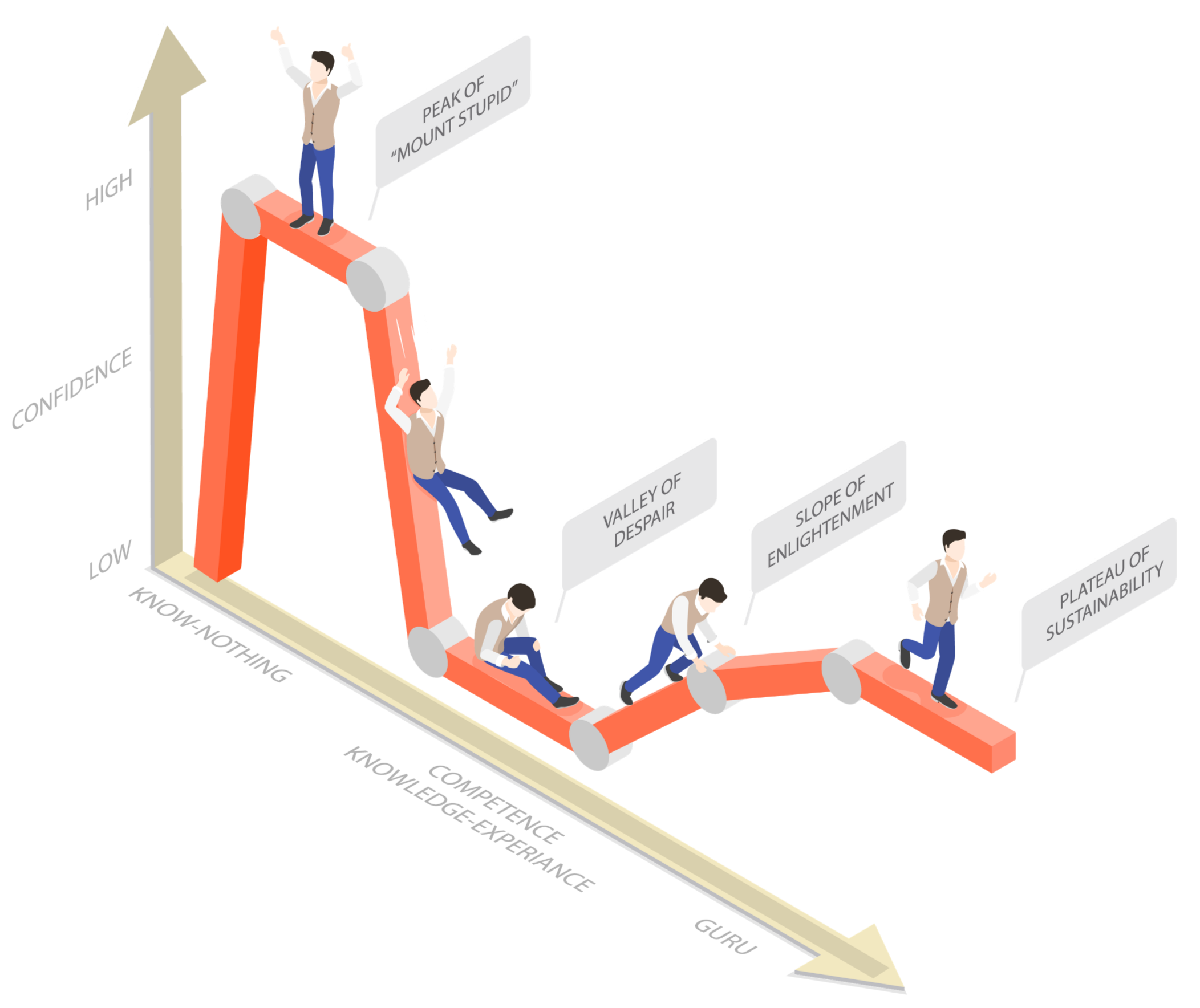
Psychologists describe the Dunning-Kruger effect as a cognitive bias in which individuals with limited knowledge or experience tend to overestimate their competence, while those with greater expertise become increasingly aware of what they don't know.
The more we learn, the more we recognize the complexity that was invisible when we first started.
What makes this phenomenon so fascinating is that the gap isn't primarily one of knowledge—it's one of awareness.
The very expertise required to solve a problem accurately is often the same expertise required to recognize the limitations of your own understanding.
Early in the learning process, we simply don't possess enough context to see what we're missing. We mistake a simple explanation for a complete explanation because we haven't yet encountered the exceptions, competing perspectives, or complexities that challenge it. As our experience grows, our confidence often becomes more measured—not because we know less, but because we've seen enough to appreciate how much there is left to understand.
You don’t know…what you don’t know
The knowledge domains I’ve adapted from Adam Grant’s book Think Again provides another useful way of thinking about expertise.
As students and young clinicians, we spend most of our time accumulating known knowns —the anatomy we can recite, the biomechanics we understand, the rehabilitation protocols we've learned. These become the foundation of our confidence.
We become overconfident and what we think we know extends beyonds the limits of our own understanding to what we think we know.
In time, as we gain experience, we begin encountering known unknowns. We recognize gaps in our understanding. We know there are questions we can't yet answer, mechanisms we don't fully understand, and athletes who don't respond the way we expected. While uncomfortable, this is often where meaningful learning begins.
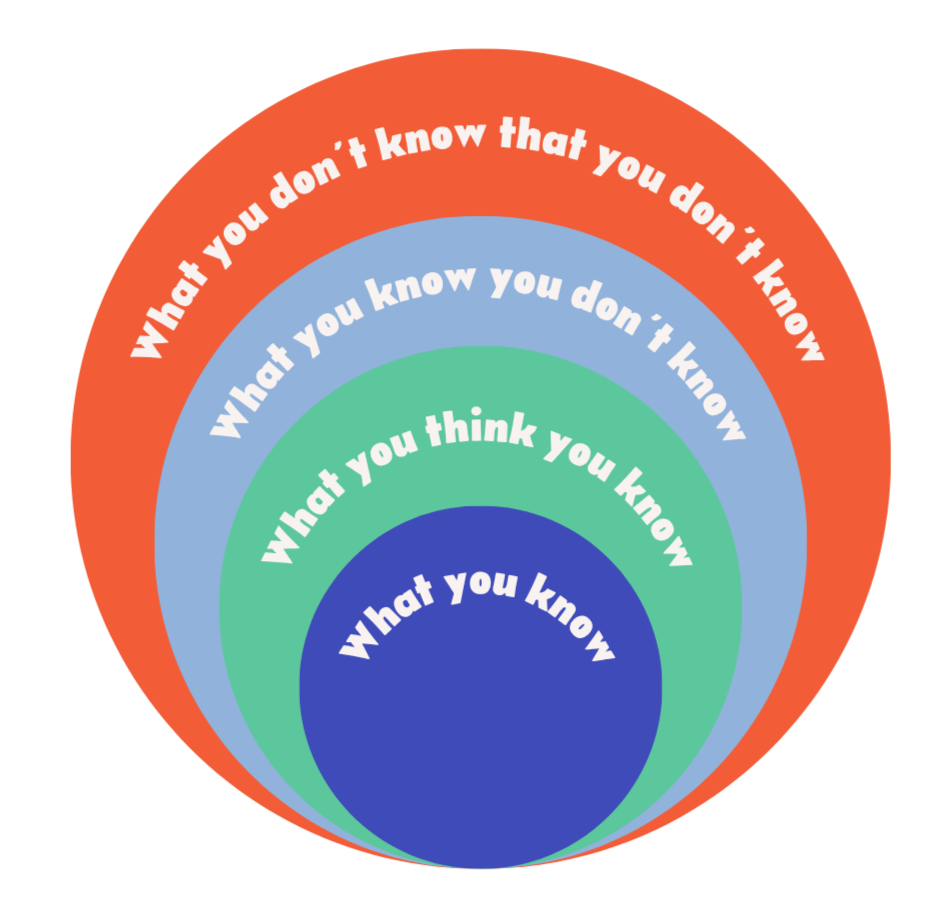
The most dangerous space, however, is the unknown unknowns. These are the things we don't know that we don't know. They're the assumptions we've never questioned, the variables we haven't considered, and the blind spots we can't yet see. Ironically, this is where overconfidence often lives. It's difficult to be curious about something you don't even realize exists.
Experience doesn't eliminate the unknown unknowns. If anything, it makes us more aware that they exist. That's one of the paradoxes of expertise. The deeper your understanding becomes, the more you appreciate how much remains undiscovered.
Confidence becomes less about having all the answers and more about being comfortable navigating questions that don't yet have one.
The nature of growth
I think rehabilitation follows a remarkably similar pattern.
Early in our careers it's easy to become attached to a philosophy, clinical framework, or system.
Everything becomes strength.
Everything becomes biomechanics.
Everything becomes neurocognitive or motor control.
Everything becomes variability.
Everything becomes pain science.
Everything becomes constraints-led.
Every new framework feels like the missing piece that finally explains rehabilitation...until it doesn't.
As our experience grows, we begin encountering athletes who don't fit our preferred explanation. The framework that worked brilliantly yesterday suddenly struggles to explain the athlete standing in front of us today. Not because the framework is wrong, but because no framework fully captures the complexity of human performance.
Frameworks vs reality
I also think we have a tendency to mistake our frameworks for reality.
We create names for approaches. We build methodologies. We develop philosophies. Over time, those ideas become identities. People become "the biomechanics clinician," "the movement variability coach," "the pain science therapist," etc.
But the athlete doesn't experience any of those labels.
They experience force, load, fatigue, learning, confidence, adaptation.
The fancy names are ours.
The reality isn't.
Every framework we use is ultimately an attempt to describe the same underlying reality: how human beings move, adapt, learn, and perform. Anatomy, physiology, biomechanics, physics, psychology, and motor learning existed long before we gave them names, and they will remain true long after today's popular philosophies have evolved into something new.
All models are wrong…some are useful

Our models are maps. They are not the territory.
That's why becoming overly attached to any one philosophy is so dangerous. It's easy to defend the map while forgetting the territory.
Methods come and go.
Technologies improve.
Research evolves.
New approaches emerge.
But fundamental principles stay the same.
Athletes will respond and adapt to stimuli.
They will learn through experience.
They will solve movement problems within the constraints of their body and environment.
They will be influenced by physiology, psychology, and the countless interactions between them.
Our understanding of those principles will continue to improve. Some of what we currently believe will inevitably prove incomplete or even wrong. That's the nature of science. The goal isn't to become attached to today's answers. It's to remain open to tomorrow's discoveries.
Rehab’s “first principles”
First-principles thinking is the process of breaking a problem down to its most fundamental truths and reasoning upward from there, rather than relying on assumptions, tradition, or existing frameworks.
So, what are our knowns"?
Human tissue adapts to the loads placed upon it.
The nervous system learns through experience.
Performance emerges from the interaction between the athlete, the task, and the environment.
Confidence influences movement just as movement influences confidence.
Most conditions have a natural history...interventions may modify the trajectory of recovery by influencing different factors (e.g., physiological, cognitive); but they do not manufacture the fundamental biological processes of healing.
These principles don't belong to any one methodology. They aren't owned by a profession, a course, or a certification. They exist apart from the letters behind our name, whether we’ve discovered them or not.
Everything else is an attempt to apply those principles to a particular athlete in a particular context.
That's where philosophies become useful. Not as answers. As tools.
Each framework emphasizes different pieces of the puzzle. One may provide a better understanding of tissue adaptation. Another may help us think differently about pain, perception, or decision-making.
The mistake is believing any single framework is the puzzle.
A practical primer
This idea is echoed throughout Robert Greene's Mastery. Greene argues that true mastery isn't marked by rigid certainty but by an enduring commitment to learning. The novice seeks answers. The master tirelessly develops their craft, continuing to fail, revise, and ask better questions.
That perspective has fundamentally changed how I approach doubt and uncertainty.
Rather than starting with a preferred method, start with what you know to be true.
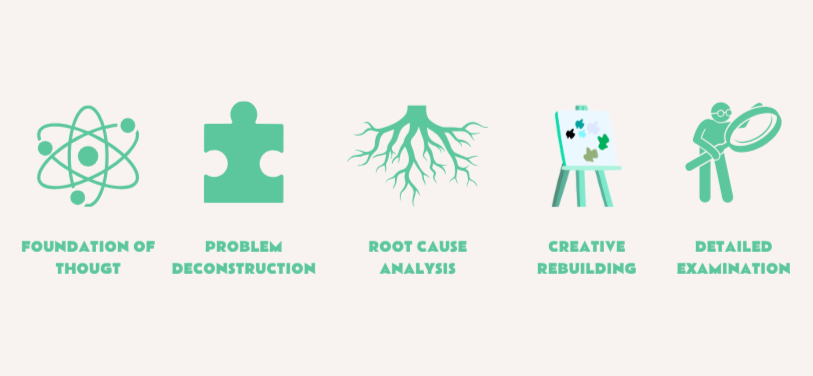
Foundation of thought: Identify the fundamental principles that govern the problem.
Problem deconstruction: Break the problem into its individual parts and constraints.
Root cause analysis: Determine what is actually limiting recovery or performance.
Creative rebuilding: Develop solutions from the fundamentals rather than defaulting to familiar methods.
Detailed examination: Evaluate the response, challenge your assumptions, and refine the plan.
Methods provide options. First principles guide decisions.
Sometimes the answer is improving strength and force production.
Sometimes it's restoring confidence.
Sometimes it's building conditioning.
Sometimes it's skill development.
Sometimes it's changing the environment.
Sometimes it's doing more…sometimes less.
The athlete doesn't care whether the solution aligns with my preferred framework. They care whether it helps them perform.
Certainty is a red flag
I've become increasingly skeptical of anyone who claims certainty in a profession as complex as rehabilitation and performance.
Not because confidence is a bad thing.
But because overconfidence often signals that someone has stopped looking for the limitations of their own thinking.
The best practitioners I've had the privilege of working with all share the same characteristics. They're incredibly knowledgeable. They're decisive when decisions need to be made. And they're remarkably humble and comfortable saying, "I don't know."
Not as an admission of weakness. As an acknowledgment that complexity deserves humility. Ironically, embracing uncertainty doesn't make us less effective clinicians. It makes us better ones. It keeps us curious. It encourages collaboration. It makes us seek perspectives outside our own discipline. It prevents us from forcing athletes into the framework we know instead of building the framework around the athlete in front of us.
Keep learning
Voltaire was right. Doubt is not a pleasant condition.
There are few things more uncomfortable than admitting you don't have all the answers while someone is trusting you with their health, career, or future.
But certainty in a profession built around complex human beings is far more dangerous.
The goal isn't to eliminate uncertainty. It's to become comfortable making thoughtful decisions despite it.
Mastery isn't knowing everything. It's remaining curious long after others stop asking questions.
Resources:
Grant A. Think Again: The Power of Knowing What You Don't Know. Viking; 2021.
Greene R. Mastery. Penguin Books; 2012.
TOMMY OTLEYPhysical therapist, sport scientist, educator, and researcher working at the intersection of rehabilitation and performance.
READ MORE

Returning to competition is an important milestone, but it does not mean performance has been restored. This edition of The Film Room explores the gap between return and performance, why performance requires an outcome, and how role, opportunity, and context complicate what “back” really means. If we say an athlete has returned to performance, we have to be able to show it.