


Hello Film Room homies! My name is Shelbie Miller and I am so honored to tag in for Tommy on a guest blog post. I hope you get two things out of this blog: one, a simple work principle that inspired this blog, and two, something to chew on this week related to change of direction.
Let’s start with the work principle
“Do something once and make it count ten times.” - Dorie Clark
This is a quote from The Long Game, and it is one of the best books I’ve ever read. It serves as a macro framework for career success. It is packed with gems like these that have changed how I approach my work.
For example, I recently finished an orthopedic manual therapy fellowship program, and one of our big projects was to create a 10 x 10 presentation. That’s 10 slides in 10 minutes. It was a great reason to take a deep dive into a topic that I enjoyed learning about. I chose change of direction (COD) mechanics for a few reasons. One, it’s an area that’s interesting and relevant to me. I like the lower extremity, and I like working with field and court sport athletes. Two, I’ve created a return-to-play presentation, which includes COD. Naturally, going on this deep dive would help me update that presentation or find holes in it. Finally, I knew I could iterate off of the presentation preparation in a variety of ways in the future. This blog is one of them!
In preparing that presentation, I tried to answer two questions:
1) Can we change COD mechanics?
2) If so, should we?
It took about 6 months from the start of my literature review to actually giving the presentation. On the outside, that sounds like overkill, right? To spend that much time and energy on a 10-minute presentation? But I wanted to do this once and make it count multiple times, and in order to do that I knew I had to do the initial version with diligence, thoroughness, and excellence.
What we’ll cover
Okay, now let’s get into the COD considerations! I like the 10,000-foot view before the details, so below is a rundown of what we’ll cover next:
Defining our terms
COD - can we change it?
COD - should we change it?
Limitations of the research
An alternative perspective on knee valgus
Defining terms
COD involves pre-planned cutting, whereas agility involves reaction and decision-making. These are different skills, independent of each other, and principles cannot be generalized from one to the other because of that [1-3].
Kinematics are related to movement strategy, joint positions, range of motion (ROM), velocity, acceleration, deceleration, etc. Conversely, kinetics have to do with forces present, muscle capacities, ground reaction forces, etc.
COD - Can we change it?
Let’s view this question through two lenses. One being a bottom-up lens and the other being a top-down lens.
I think of bottom-up as being direct and explicit methods to change someone’s cutting mechanics through coaching cues or constraints. On the other hand, top-down is more indirect. For example, improving someone’s capacity upstream to impact movement strategy downstream.
So can we change cutting mechanics?? Short answer: yes!
Let’s start with bottom-up…after 6 weeks of what Dos’Santos’ et al. research group called “technique modification training,” the researchers found improvements in both kinematic and kinetic qualities [4-6]. This training consisted of 20-30 minute coaching sessions twice a week, where subjects progressed from predictable, low intensity cuts to reactive cuts at higher intensities while receiving specific coaching cues. Dos’Santos’ group was able to coach subjects in such a way that demonstrated improved foot position, foot plant distance, trunk angle, faster completion time, and greater propulsive force application in shorter ground contact times.
Through a top-down lens, let’s zoom out a bit and consider how we might indirectly improve COD ability. We can improve deceleration capacity by improving eccentric quadriceps strength. We can improve stretch-shortening cycle utilization, rate of force development and neuromotor coordination through a variety of plyometric methods. Finally, we can increase technical efficiency, or center of mass management, through hip and core strengthening to minimize energy leaks during COD.
A more nuanced answer requires us to consider a few critical questions.
What is the external validity? Can these findings be generalized? The population used across these studies by Dos’Santos consisted of multidirectional male soccer athletes 16-33 years old. While the training sessions did include some reactive cutting in the final two weeks, the pre and post-intervention assessments were pre-planned cuts that did not include a reactive component. For these reasons, I would caution against extrapolating these findings to agility tasks or to female athletes.
A big question mark also exists around the treatment effect. These athletes were tested immediately once the six week intervention ended. How long do these changes last? We don’t know.
An interesting finding from one of these papers was that there were no meaningful changes in knee joint loads as a group, but when the authors looked on an individual level, those with high multiplanar knee joint loads pre-intervention (aka higher risk) responded positively and demonstrated reductions [6].
When I read that I thought of what I call the Erik Meira Razor. A razor is a rule of thumb. I’ll explain in the next section what I mean!
COD - Should we change it?
“If it makes you wanna throw up, then intervene.” - Erik Meira
I can’t remember where I first heard Erik say this, but it stuck with me as an easy, pragmatic decision making tool. In that last paper I mentioned, I found it interesting that those at highest risk benefitted most from the intervention.
Furthermore, we should keep in mind the Performance-Injury Conflict [7], which challenges us to remember that, “techniques and mechanics associated with faster performance are in direct conflict with safer COD mechanics.” The authors argue against coaching soft, quiet braking strategies because they reduce performance. Instead, they encourage practitioners to have athletes execute effective braking steps by “slamming on the brakes” and lean in their intended direction by “looking in the direction you’re about to go.”
It’s easy to get lost and feel stuck with this stuff. I try to be pragmatic. I will intervene if someone’s COD makes me wanna throw up, if there’s a strategy that is impeding performance, or if their movement solution space seems too narrow. For example, if someone avoids cutting off a particular limb after a surgery again and again, but they have the capacity to do so based on objective testing, I may step in with feedback or a task constraint to expose other movement solutions so that the athlete develops a robust movement repertoire.
Limitations of the research
Ecological validity has to do with how much we can generalize research findings to the real world. In 2023 Kadlec et al. [8] made a few interesting points around preparing athletes for the “worst case scenario.”
First, they proposed that athletes can “gamble” their motor responses in a lab setting without any real consequences. In most COD papers, the environment is sterile, stable and controlled, making it difficult to pull out principles and apply them to live, chaotic sport settings.
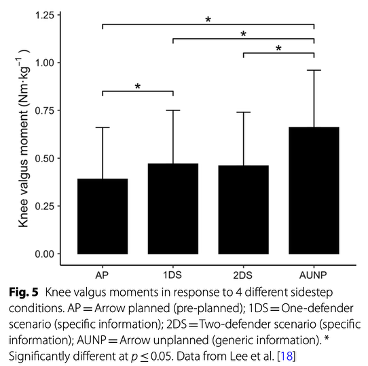
Second, they argued that we need to consider the relationship between stimuli used, the opportunity for anticipation, and how that translates to knee joint loading. They reference two papers by Lee et al., who had subjects complete sidesteps under four conditions [9, 10]. Two conditions utilized a simple, generic arrow stimulus, either planned or unplanned, and the other two conditions utilized a specific, three-dimensional (3D) video projection of either a single or double-defender scenario that the subject had to read and react to (Figure 5).
Interestingly, the authors found that providing subjects with specific stimuli via 3D defenders improved their ability to anticipate and cut with lower knee joint loads when compared to reacting to a simple, generic stimulus like an arrow (Figure 6).
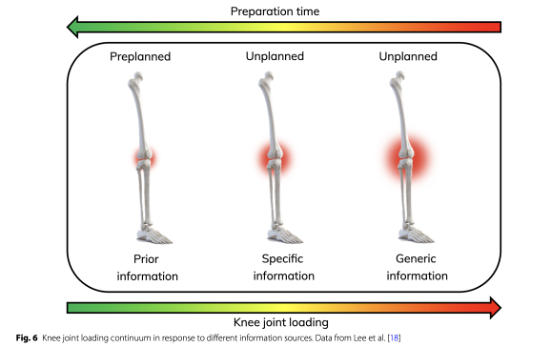
I think this is a great reminder that while arrows and lights are considered simple stimuli, they may be robbing our athletes the opportunity to anticipate and orient their body effectively during a cutting maneuver.
Finally, a few other general considerations on the limitations of research. Many of these studies assess COD using short entry distances of 5-15 meters. Naturally, shorter entry distances will constrain entry velocity, and lower entry velocity means lower knee joint loads. Keep these things in mind when extrapolating findings from these studies to reactive agility under higher speeds, longer distances and with implements like balls, sticks, etc. that are also being managed when cutting in sport.
An alternative perspective on knee valgus
I want you to imagine looking at a diamond. This diamond represents ACL injuries. So often we have been taught to hold that diamond in such a way that we’ve only seen knee valgus as the culprit behind ACL tears.
I’d like to invite you to turn that diamond to the side a bit and consider some alternative perspectives that challenge the idea that knee valgus is inherently bad or the sole cause of ACL injuries. Why? Because when we talk about whether or not to intervene on someone’s COD strategy, knee valgus is often the first thing we look for.
When assessing bone bruise patterns, Zhang et al. suggest that the primary mechanism of ACL tears is the large anterior tibial translation that occurs at ~15 degrees of knee flexion, and that knee valgus and tibial internal rotation are post-tibial anterior translation events [11].
Building off of this idea, both Boden [12] and Petway et al. [13] investigated mechanisms of ACL tears and shared conclusions that made me pause. They argue that landing and cutting with an extended knee posture under a large deceleration moment involves axial compression forces that pose a greater concern for an ACL tear than knee valgus itself.
Further, Dr. Boden performed video analysis of ACL injuries and compared them to noninjured controls. He notes that significant differences in knee valgus between injured and noninjured athletes were not detected until 67ms after initial contact. For context, ACL injuries occur within 17-50ms.
Maybe it’s not as simple as “knee valgus causes ACL tears, therefore we need to avoid knee valgus.” Maybe we need to reframe knee valgus as a contributing factor to, or even the result of, an ACL tear. It seems reasonable to shift our focus and attention towards ensuring athletes can land and cut with adequate knee flexion rather than whether or not they move into valgus.
Thank you for reading
Shelbie
Connect and hear more from Shelbie at:
References:
Morral-Yepes M, Gonzalo-Skok O, Dos Santos T, Moras Feliu G. Are change of direction speed and agility different abilities from time and coordinative perspectives?. PLoS One. 2023;18(12):e0295405. Published 2023 Dec 7. doi:10.1371/journal.pone.0295405
Čoh M, Vodičar J, Žvan M, et al. Are Change-of-Direction Speed and Reactive Agility Independent Skills Even When Using the Same Movement Pattern?. J Strength Cond Res. 2018;32(7):1929-1936. doi:10.1519/JSC.0000000000002553
Ciocca G, Tessitore A, Tschan H. Agility and change-of-direction speed are two different abilities also during the execution of repeated trials and in fatigued conditions. PLoS One. 2022;17(6):e0269810. Published 2022 Jun 10. doi:10.1371/journal.pone.0269810
Dos'Santos T, Thomas C, Comfort P, Jones PA. Biomechanical Effects of a 6-Week Change of Direction Speed and Technique Modification Intervention: Implications for Change of Direction Side step Performance. J Strength Cond Res. 2022;36(10):2780-2791. doi:10.1519/JSC.0000000000003950
Dos'Santos T, McBurnie A, Comfort P, Jones PA. The Effects of Six-Weeks Change of Direction Speed and Technique Modification Training on Cutting Performance and Movement Quality in Male Youth Soccer Players. Sports (Basel). 2019;7(9):205. Published 2019 Sep 6. doi:10.3390/sports7090205
Dos'Santos T, Thomas C, Comfort P, Jones PA. Biomechanical Effects of a 6-Week Change-of-Direction Technique Modification Intervention on Anterior Cruciate Ligament Injury Risk. J Strength Cond Res. 2021;35(8):2133-2144. doi:10.1519/JSC.0000000000004075
Dos'Santos T, Thomas C, McBurnie A, Comfort P, Jones PA. Biomechanical Determinants of Performance and Injury Risk During Cutting: A Performance-Injury Conflict?. Sports Med. 2021;51(9):1983-1998. doi:10.1007/s40279-021-01448-3
Kadlec D, Miller-Dicks M, Nimphius S. Training for "Worst-Case" Scenarios in Sidestepping: Unifying Strength and Conditioning and Perception-Action Approaches. Sports Med Open. 2023;9(1):22. Published 2023 Apr 5. doi:10.1186/s40798-023-00566-8
Lee MJ, Lloyd DG, Lay BS, Bourke PD, Alderson JA. Different visual stimuli affect body reorientation strategies during sidestepping. Scand J Med Sci Sports. 2017;27(5):492-500. doi:10.1111/sms.12668
Lee MJ, Lloyd DG, Lay BS, Bourke PD, Alderson JA. Effects of different visual stimuli on postures and knee moments during sidestepping. Med Sci Sports Exerc. 2013;45(9):1740-1748. doi:10.1249/MSS.0b013e318290c28a
Zhang L, Hacke JD, Garrett WE, Liu H, Yu B. Bone Bruises Associated with Anterior Cruciate Ligament Injury as Indicators of Injury Mechanism: A Systematic Review. Sports Med. 2019;49(3):453-462. doi:10.1007/s40279-019-01060-6
Boden BP, Sheehan FT. Mechanism of non-contact ACL injury: OREF Clinical Research Award 2021. J Orthop Res. 2022;40(3):531-540. doi:10.1002/jor.25257
Petway AJ, Jordan MJ, Epsley S, Anloague P, Rimer E. Mechanisms of Anterior Cruciate Ligament Tears in Professional National Basketball Association Players: A Video Analysis. J Appl Biomech. 2023;39(3):143-150. Published 2023 Mar 31. doi:10.1123/jab.2022-0266
SHELBIE MILLERShelbie Miller, PT, DPT, SCS, is a sports physical therapist at TCU. She is the creator and host of The Rethinking Rehab Podcast, where she explores evolving perspectives in rehabilitation, performance, and sports medicine through conversations with practitioners across the field. Shelbie is also involved with Clinical Athlete and is passionate about bridging rehabilitation and performance while encouraging clinicians to critically examine and refine their practice.

READ MORE

We often see movement we want to change, but just because we can change it does not always mean we should. This guest edition of The Film Room from Shelbie Miller explores change-of-direction mechanics, the difference between changing movement directly versus building the capacity that shapes it, and why performance, injury risk, and the demands of the task all matter when deciding whether to intervene. Movement is a problem to understand before it is a problem to fix.